Best fit
- Controlled-site payload movement
- Emergency-supply and sample-transfer trials
- Teams evaluating gripper-based pickup and drop
autonomous delivery drone
Connect route planning, distance measurement, obstacle awareness, payload handling, and human supervision for controlled delivery workflows.
Mission capability
Configure autonomous delivery drones for payload pickup and drop using grippers, depth sensing, LiDAR, telemetry, and Pixhawk/ArduPilot safety.
Pilot decision guide
A delivery-drone pilot should validate the complete payload workflow—pickup, secure transport, obstacle-aware routing, destination approach, release confirmation, and operator recovery—not only point-to-point flight.
How the system works
Each layer is configured around the aircraft, operating environment, sensor stack, safety requirements, and level of human supervision.
A delivery workflow coordinates pickup location, payload state, flight route, obstacle checks, destination approach, release conditions, and confirmation evidence.
Depth sensing can help estimate distance to objects, surfaces, or pickup targets during close-range interaction, subject to the selected sensor and environment.
LiDAR provides range information for obstacle-aware movement along the mission route and near controlled pickup or drop zones.
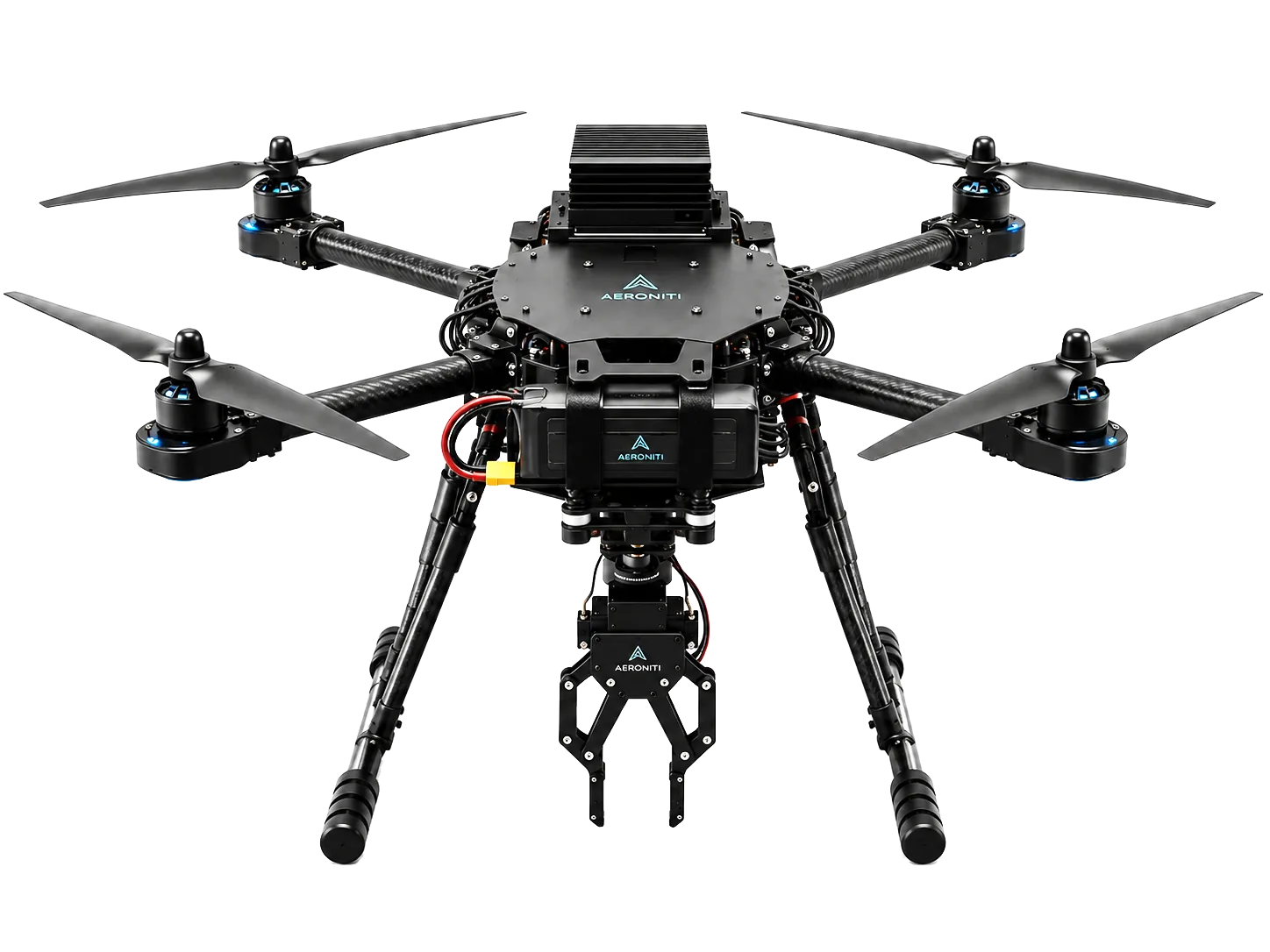
The payload workflow can coordinate gripper open, close, lift, transport, and release actions with sensor checks and mission stages.
CargoLift can combine a depth camera, 360 LiDAR, autonomous gripper, Jetson Orin Nano, Pixhawk 6C, telemetry, and Aeroniti mission software.
Operators monitor telemetry and payload state and can approve, pause, redirect, return, or land according to the deployed control workflow.
Frequently asked questions
Practical answers for teams assessing an Aeroniti mission configuration.
A configured workflow uses positioning, depth or visual sensing, mission logic, and a controlled gripper sequence to approach and secure a suitable payload.
LiDAR and other sensors can support obstacle-aware decisions, but performance depends on payload, speed, environment, sensor coverage, and testing.
Payload capacity depends on the final airframe, propulsion, battery, gripper, center of gravity, regulations, and required safety margin.
Yes. The workflow can require operator approval or provide operator override for payload actions.
Operations must follow local aviation, safety, privacy, and site-access rules. Aeroniti focuses on controlled and properly authorized mission environments.
Request demo
Share the mission, aircraft, operating environment, sensors, payload, safety constraints, and expected outcome. Aeroniti can define a focused integration and field-validation path.